Perspective
AI is Expanding Across the Stack
Caryn Marooney
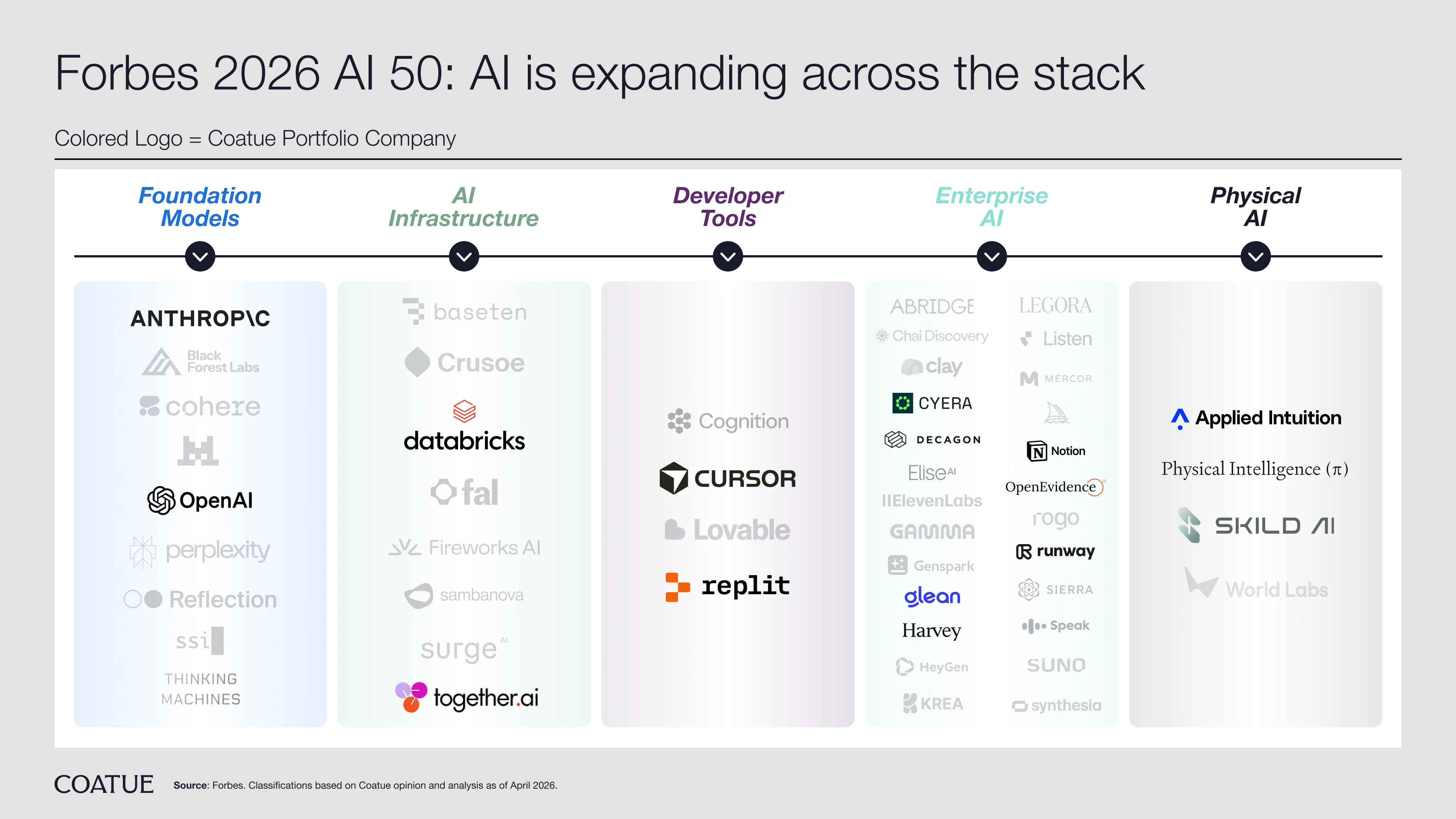
Forbes just released its eighth annual AI 50, recognizing the 50 most promising private AI companies in the world. Coatue has 16 portfolio companies on this year's list, spanning every major layer of the AI stack: foundation models, infrastructure, developer tools, enterprise applications, and physical AI.
This year's list tells a clear story about where AI is headed. The enterprise layer is where the most growth is happening. The zone where AI meets specific industries and workflows produced more new entrants than any other. Nearly half of the AI 50 now falls into this group.
Where the value is forming
The AI conversation often centers on a single question: who has the best model? That question still matters, but the 2026 AI 50 makes clear that the market has expanded well beyond it.
Consider the composition of the list. It spans frontier model builders like Anthropic and OpenAI, infrastructure players like Databricks and Together AI, and tools like Cursor and Replit that are changing how software gets written. It also features companies like Glean, Harvey, Notion, and Runway embedding AI into specific workflows, though Runway’s video generation model is a reminder of how porous these categories have become. Applied Intuition, Physical Intelligence, and Skild AI, meanwhile, are pushing AI into the physical world, where the stakes and engineering challenges are entirely different.
What the list signals
Three patterns stand out.
First, the market is expanding outward from the models. Nearly half the companies on the list are in enterprise AI, more than foundation models, infrastructure, developer tools, and physical AI combined. Twenty new companies debuted on the list this year, and the majority are application-layer businesses solving specific vertical problems.
Second, infrastructure matters. The presence of Databricks and Together AI on the list is a reminder that building a great model is only part of the equation. Running AI at scale requires specialized systems for data, compute, and deployment, and the companies building those systems are becoming increasingly important.
Third, the physical world is next. The inclusion of multiple robotics and embodied AI companies signals the next frontier. Foundation models are being applied to domains such as manufacturing, logistics, autonomous vehicles, and surgical systems, where the total addressable market dwarfs software alone.
What comes next
The 2026 AI 50 is a snapshot of a stack that is still being built. The models remain the center of gravity, but the list makes clear that the opportunity has spread well beyond them. Value is forming at every layer: in the infrastructure that makes scale possible, in the tools that make developers faster, in the applications that make AI useful, and in the physical systems that will eventually make AI present in the world, not just on a screen.
The pace of change is extraordinary. The enterprise layer barely existed as a category a few years ago. Physical AI felt theoretical not long ago. Coatue has 16 portfolio companies on this year's list. We're proud of what they're building, and we can't wait to see where it goes.